C is for Citrus

🍊🍋🍊🍋🍊🍋🍊🍋🍊🍋🍊🍋
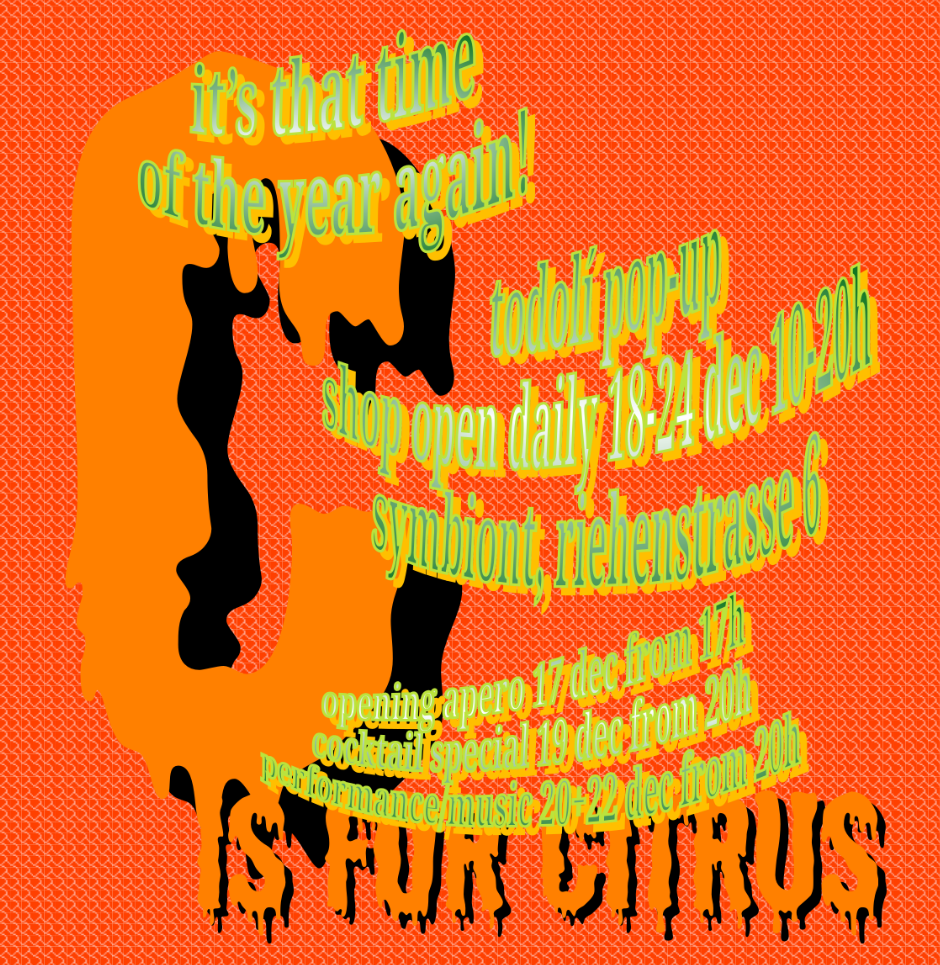
they’re here! over 20 varieties of @todolicitrusfundacio marvels, ready to be tasted from tomorrow evening on, until christmas. get them as long as stocks last!
🍊🍋🍊🍋🍊🍋🍊🍋🍊🍋🍊🍋
todolí pop-up
shop open daily 18-24 dec 10-20h

there’s not only fruits! we have an evening program to go with the todoli citrus shop

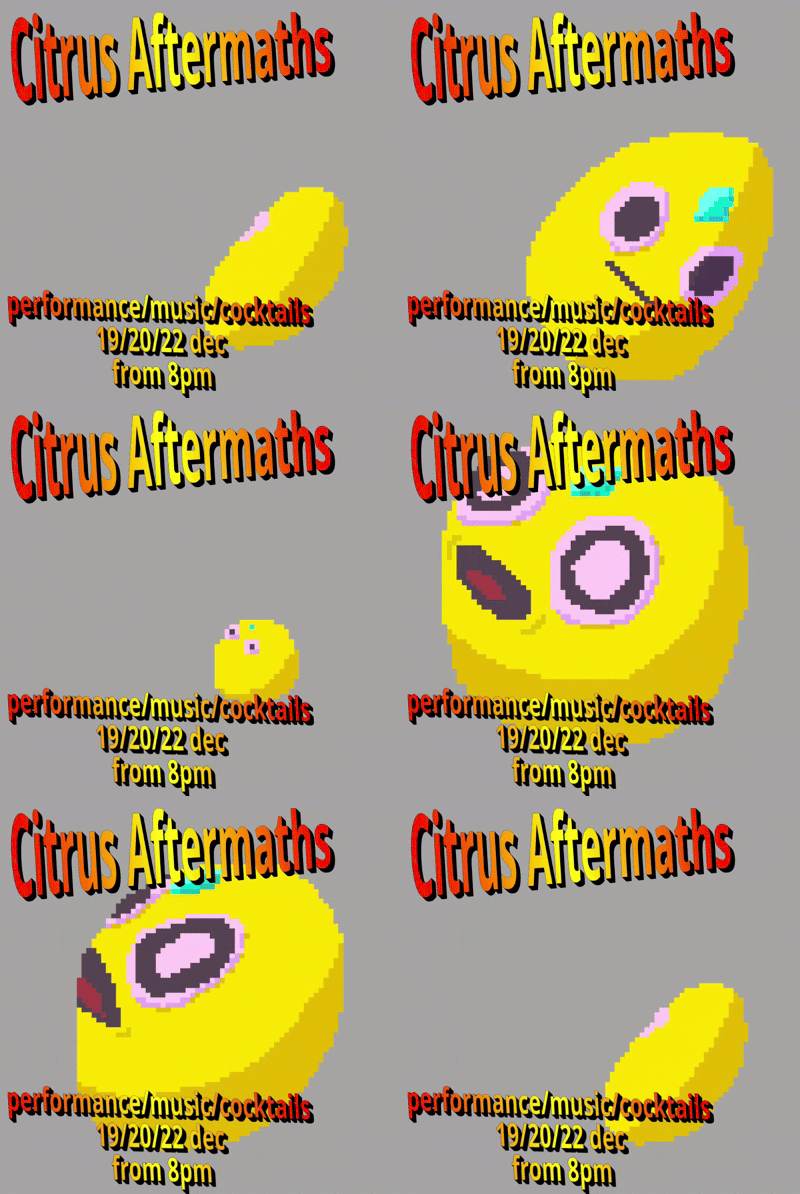
cocktail special 19 dec from 20h

performances/music in odoriferous atmosphere, brought to you by ben kaczor

sat 20 dec
20:30 – 21:00 performance by sanja lukanović & simon baumann
followed by music by damla

mon 22 dec
20:30 – 21:15 agnes leclaire live
21:30 listening session: papiro’s new album “Uscire Da Fuori”

art basel special: we all scream (for i scream), kaspar könig and friends

inflatable organ/EARphones plus homemade ice cream open every day from noon til 7pm (or longer)mon 4-6pm: blowing things up (kind of an opening)wed 5pm: launch of the post research dinner series (with instrumental prelude)fri 8pm: bar and music

once a month, we invite researchers working outside of institutional research contexts and discuss their research practice, the challenges, the pros and cons, the experiences with institutions, the freedom of freelancing.
ah, why post, you might ask? think pluralism, think anti scientific method monopoly, think epistemological anarchy. we’ll talk about that more in detail, for sure.

launch this wednesday with Kaspar König, sound artist, hacker, inventor, listener (and much more)

tuning in from 5pm: apero and live music in the inflatable organ with Kaspar König, Jope Schneider and friends
dinner discussion from 8pm: Kaspar König in conversation with Roland Fischer

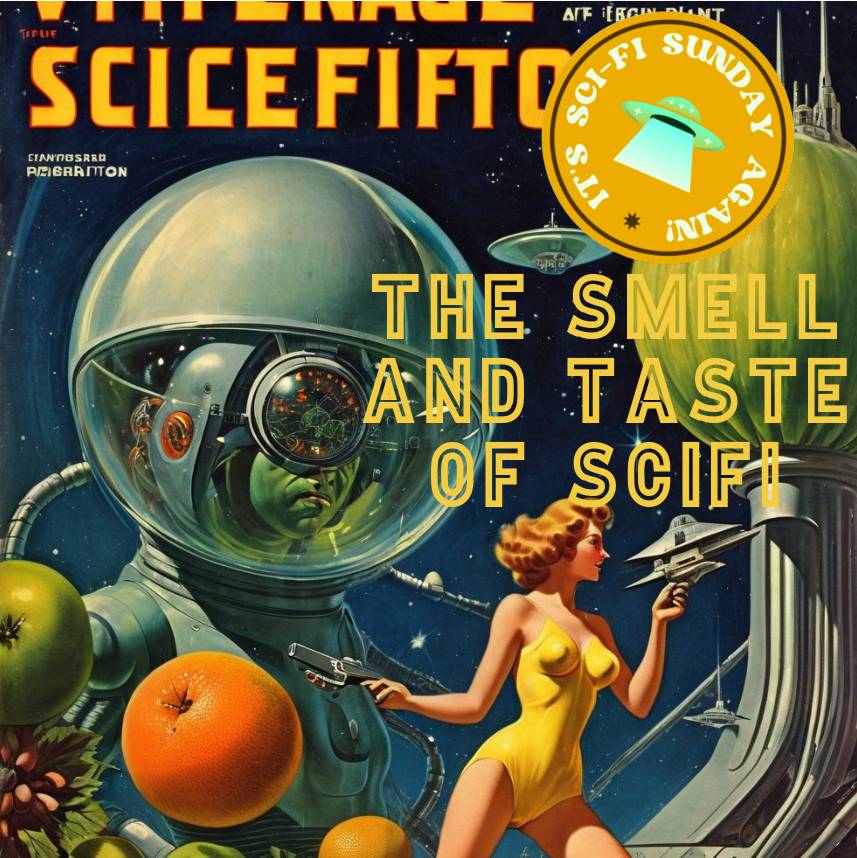
Sci-Fi Sunday! 27 April 18h – Chinese SciFi

Zu Gast: Jessica Imbach, Junior Professor in Freiburg and specialist for aesthetics and politics of genre fiction in China, focusing in particular on science fiction

Wir werden also über Fortschrittsglauben und -geschichten in China reden – und wie sich das vom Westen unterscheidet. Gibt es überhaupt so etwas wie eine “chinesische” SciFi-Tradition? Was wäre daran charakteristisch? Lässt sich via SciFi Gesellschaftskritik leichter an den Zensoren vorbeischmuggeln?

What started in 1985 as an intellectual debate on the meaning and relevance of tradition (Confucianism in particular), science, and Western theory to China’s integration into the global economic system, was by the time it violently ended in 1989 a nation-wide discussion on national identity and globalisation that also had an enormous influence on popular culture.

Und was hat es mit dem Sinofuturismus auf sich?

Screening: Civilization, Technology and Consciousness

11. April, 6pm
screening: 7.30
cocktails and exchange with Felix Stalder after

Peter Lamborn Wilson / Hakim Bey

A video by World-Information.Net – Konrad Becker/Felix Stalder

In his last interview, cultural theorist Peter Lamborn Wilson draws a wide arc through the history of civilization, technology and consciousness. As the author of “Temporary Autonomous Zone” and dozens of other books, including titles like “Pirate Utopias”, he inspired several generations. He died one day after the last recording of this interview in May 2022.

post research
regular dinner discussions, fostoering a wide plurality of research cultures

post research as in post modern – not as a position that overcomes the concept of research and leaves it behind, but as a position of complexity:

If there is a common denominator to all these postmodernisms, it is that of a crisis in representation: a deeply felt loss of faith in our ability to represent the real, in the widest sense. No matter whether they are aesthestic [sic], epistemological, moral, or political in nature, the representations that we used to rely on can no longer be taken for granted.

contamination #1

Civilization, Technology and Consciousness

Friday 11 April, from 6.30 pm
screening: 7.30
cocktails and exchange with Felix Stalder (ZHdK) after

Peter Lamborn Wilson / Hakim Bey

A film by World-Information.Net – Konrad Becker/Felix Stalder

In his last interview, cultural theorist Peter Lamborn Wilson draws a wide arc through the history of civilization, technology and consciousness. As the author of “Temporary Autonomous Zone” and dozens of other books, including titles like “Pirate Utopias”, he inspired several generations. He died one day after the last recording of this interview in May 2022.

Camera: Fred Barney Taylor, NY Support: Jim Fleming, Lewanne Jones

Postproduction: Georg Schütz, Sound: Konrad Becker

(57min. 2022)

Felix Stalder is a professor for Digital Culture at the Zurich University of the Arts. His work focuses on the intersection of cultural, political and technological dynamics, in particular on new modes of commons-based production, control society, copyright and transformation of subjectivity. He not only works as an academic, but also a cultural producer, being a moderator of the mailing list , and member of World Information Institute in Vienna, as well the “Technopolitics Working Group (both in Vienna). Among his recent publications are “Digital Solidarity” (PML & Mute 2014) and “The Digital Condition” Polity Press, 2018).

fs.zhdk.ch
felix.openflows.com

he citrus are back! 21-23 march, todoli spring edition

open friday-sunday 10am until evening, with cocktails on friday, food on saturday, scifi special on sunday

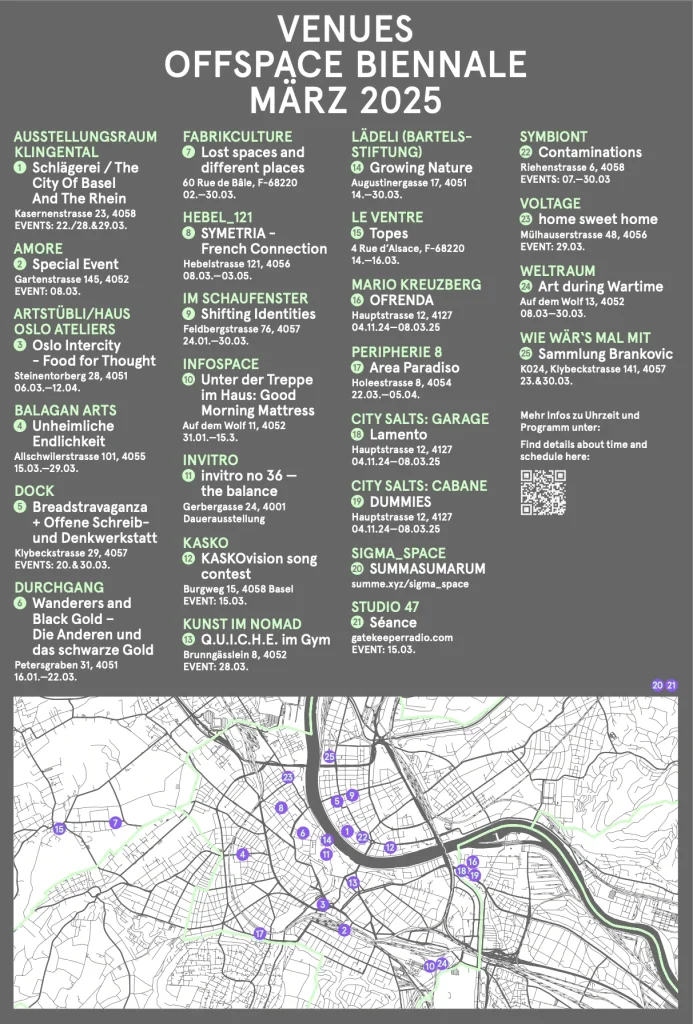
symbiont macht mit bei der ∑ SUMME Biennale 2025!

Der symbiont als pluriversité populaire: wir präsentieren eine Reihe von «Kontaminationen», experimentellen Begegnungs- und Diskutierformaten, um uns gegenseitig mit Ideen und Gedanken-Memen anzustecken. Keine Reinheitsgebote, nichts für Puristen! Hier wird mit Lust gemixt und durcheinander gebracht. Es gibt Cocktails, es gibt Bücher, es gibt Kaffee und Kuchen.

All I have done … is dominated by the thought of a virus, what could be called a parasitology, a virology, the virus being many things…. The virus is in part a parasite that destroys, that introduces disorder into communication. … . On the other hand, it is something that is neither living nor non-living.
Jacques Derrida

experimental!

wir lancieren ein neues Kinderformat: der anarchowissenschaftliche Labor-Nachmittag

erste Ausgabe zum Thema “Kristall”
Samstag 15. März, ab 14 Uhr

Wir züchten Kristalle, betrachten sie unter dem Mikroskop, machen Experimente. Spass steht im Vordergrund!

bei Fragen/gern anmelden! info@symbiont.space

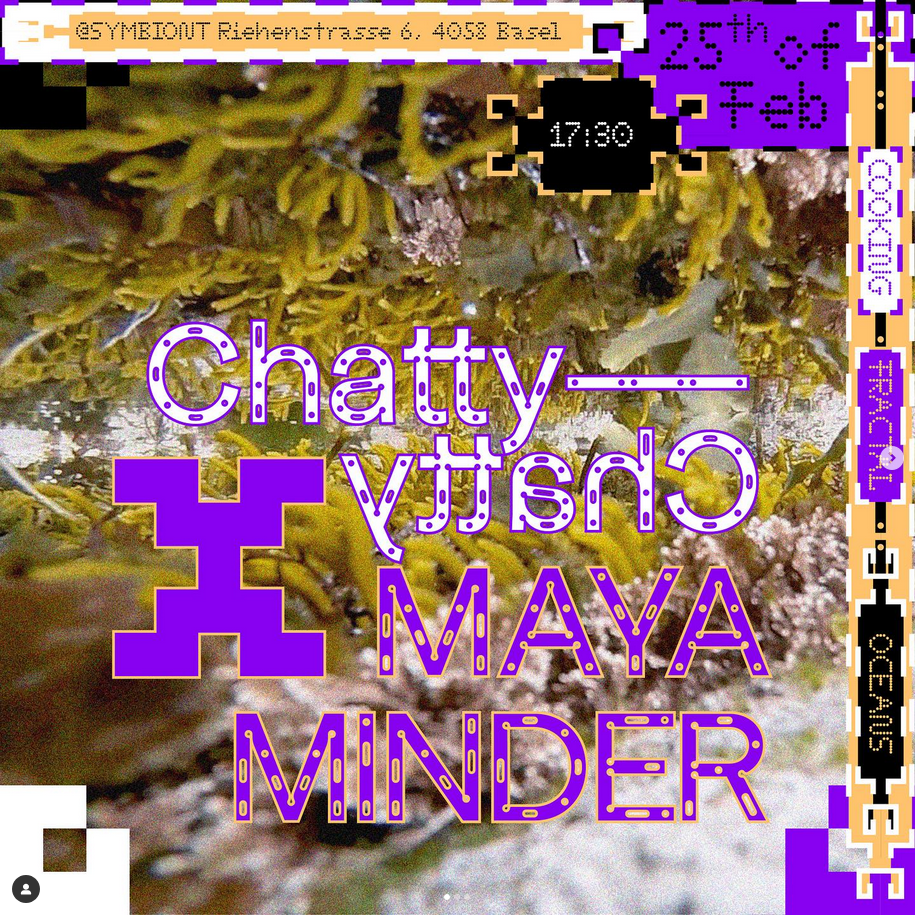
chatty chatty

✦((✧:●:✧))✦ Chatty Chatty No. 5 with MAYA MINDER @symbiont.space ✦((✧:●:✧))✦

:::⁠🪸:::⁠

We look forward to the next event in our student-led talk series “Chatty Chatty” on the 25th of February, 5:30pm open doors and 6pm Workshop start

:::⁠🪸:::⁠ 🪸:::⁠

For Maya Minder, ⁠Cooking serves to reveal the metaphor of the human transformation of raw nature into cooked culture and she combines it to the evolutionary ideas of a symbiotic co-existence between plants, animals and humans.

What if the ocean would be sweet not salty? (hands-on Workshop)

So unfamiliar to inland people, the Ocean has been shaping seaside-community’s way of habits and cooking practices living in its proximity. They follow the circadian and lunar rhythm of the tides, things move in the fluidity of the waves, repetition and time are inscribed in daily practices. The environment has effects on humans and how they perceive daily life. Oceans such as Mountains give spiritual influence to humans, where men subsides to natural forces and the awareness that the more significant cause is bigger than the self. This workshop tries to fractal our perception towards materiality and existence. In this hands-on experience creating sweet Japanese crystals while playing with fractal shapes, similar to them.

:::⁠🪸:::⁠ 🪸:::⁠ 🪸:::⁠ 🪸:::⁠

Lemon Dumplings and fizzy drinks provided by the sweet “To Fold Dough Around Filling” ⁠student crew^^

Daig

eine Mikrobiosoziologie
partizipatives Forschungs- und Diskussionsprojekt mit Backstube und Labor

making and baking dough and reflecting about the daig – with performances, talks, discussions, sourdough workshops

dates tbc

Was ist das eigentlich, ein Teig? Man kann es von der Konsistenz her anschauen: eine weiche, dehnbare Masse. Oder von der Zubereitung her: eine aus Mehl und Wasser bestehende Masse, die geknetet werden muss. Oder vom Zweck her: eine Masse, die (meist) gebacken und dann (meist) gegessen wird.
Oder man kann es mikrobiologisch anschauen, das ist vielleicht am spannendsten: sehr oft ist ein Teig ein komplexes Biotop, in dem Mikroorganismen leben und eine von uns erwünschte Wirkung erzielen. Die Masse wäre insofern nur die Matrix, in der drin sich so einiges ereignet, das für uns normalerweise unsichtbar bleibt. Im Sauerteig sind es Milchsäurebakterien, im Hefeteig sind es eben Hefen. Bloss im klassischen Rührteig steckt nicht besonders viel Biologie – hier sorgt Backpulver auf eher langweilig chemisch-physikalische Weise für Luftigkeit.
Wir wollen diese Teig-Materialität partizipativ erkunden, wir werden einen grossen Backtisch in den pickpockets.space stellen und jeden Tag neue Teige machen. Die Materialität ist natürlichverwandt mit der Keramik (und auch da spielt der Ofen zum Schluss hin eine wesentliche Rolle), deshalb spannen wir mit «Wett» – Atelier für plastisches Wirken zusammen, über die neue Grünanlage beim Wettsteinhäuschen hinweg. Darf man Teig auch als Skulptur behandeln? Oder wäre das «mit dem Essen gespielt»?
Jeder Teig ist anders, das gilt nicht nur für verschiedene Rezepte, sondern eben tatsächlich für jedes «Individuum» – vielleicht ist ein Teig tatsächlich ein wenig ein lebender Organismus. Denn jeder Teig hat seine charakteristische Mikroflora: auch im Sauerteig gibt es Hefepilze, auch im Hefeteig gibt es Bakterien. Diese Flora hat ein sprichwörtliches Eigenleben. Zusammen mit dem Biokünstler-Netzwerk Hackteria gehen wir diesem Biom auf den Grund – der symbiont wird zu einem Labor und Forschungsort, mit allen nötigen Analyse-Utensilien, Mikroskopen etc. Welche Wildhefen gibt es im Raum Basel? Was wissen wir über die Wechselwirkungen der verschiedenen in den Teigen lebenden Mikroorganismen? Diese Forschung wird immer zum Mitmachen einladen: Mikrobiologie zum Ausprobieren, Citizen Science im ganz zupackenden, spielerischen Sinn.
Gleichzeitig bietet das gemeinsame Teigen eine niederschwellige Gelegenheit, über Soziologien des (städtischen) Zusammenlebens nachzudenken. Teige funktionieren nämlich auch bestens als Metapher: auf kleinem Raum leben eine Unzahl von Mikroorganismen in schönster Koexistenz (und weniger wohl in gnadenloser Konkurrenz). Sie sind sehr wahrscheinlich alle aufeinander angewiesen, damit ein Sauerteig immer schön weiterwächst. Insofern spielt es auch nicht so eine Rolle, dass es da einen etymologischen Schönheitsfehler gibt und der Basler Daig vom Deich herkommt, als begrenzender Wall um die Innenstadt. Als Metapher funktioniert der Teig für eine
Stadtsoziologie ja einiges besser.

Insgesamt will Daig Anstösse geben, um über das Zusammenleben in der Stadt nachzudenken, eine soziale Situation schaffen, die den Austausch erleichtert und Menschen aus ganz verschiedenen Gesellschaftsschichten zusammenbringt.
Und das Projekt will das Bewusstsein schärfen für die Lebendigkeit von Lebensmitteln, für
Prozesse, die auf Mikroorganismen beruhen. Und deren Tätigkeit positiv bewerten: Einzeller sind nicht immer Krankheitserreger, die man besser weg-desinfiziert. Sondern leisten einen wichtigen Beitrag zu nachhaltig produzierten und gesunden Lebensmitteln. Ein Symposium wird Sauerteigexpertinnen aus dem In- und Ausland versammeln, zusammen mit den eingeladenen Künstlerinnnen werden wir über Fermentation, totes und lebendiges Material und Eat Art diskutieren.